When Is It Safe to Plant Outdoors in Maine?
Maine gardeners often face the same spring dilemma: the calendar says it is time to plant, but the soil is cold and frost is still possible. There is no single safe planting date for the whole state. The reliable approach is to match each crop to local frost risk, soil conditions, and its tolerance for cold.
What “safe to plant” means in Maine
A plant can go into the ground and still struggle if conditions are wrong. “Safe” is best treated as a set of checks, not a date on the calendar: Is the soil workable? Can the plant tolerate the temperatures ahead? Is frost likely? Can you protect it if the forecast changes?
Maine’s growing conditions vary from coast to interior, north to south, and even between nearby yards. A sheltered bed beside a sunny wall may warm sooner than an exposed garden on a hill. A low spot can collect cold air and stay frost-prone after higher ground has warmed. Those differences make a statewide planting date misleading.
Plant type matters just as much. Peas and many leafy crops tolerate cool weather better than tomatoes, peppers, cucumbers, and other tender plants. Some seeds can be sown directly in cool soil; others may sit without growing, or rot, if the ground is cold and wet. A transplant that has spent its life indoors also needs time to adjust to outdoor sun, wind, and temperature swings.
Use these checks together:
- Crop tolerance: Does the seed packet or plant information describe the crop as cold-tolerant or tender?
- Frost risk: Is a frost still possible in your area, and could you protect the plants if one occurs?
- Soil condition: Can you work the soil without smearing or compacting it?
- Plant readiness: Are indoor-grown seedlings hardened off and sturdy enough to go outside?
- Local conditions: Is your garden exposed, shaded, low-lying, coastal, or sheltered?
A favorable forecast is helpful, but it does not guarantee frost-free weather. Local frost dates are probabilities based on records from weather stations, not promises about what will happen in a particular yard or year. See How to Read Local Frost Dates for Your Maine Garden Site for help interpreting those estimates.
Why Maine has no single planting date
Planting schedules are useful starting points, but Maine’s geography and spring weather make them estimates rather than statewide instructions. A calendar for one region may be too early for another, and even a schedule that fits your town may not account for your garden’s slope, shade, or wind exposure.
Coastal areas and inland gardens can warm at different rates. Northern and interior locations may hold cold conditions later into spring than a protected southern coastal site. Elevation and exposure also matter: a windy, open garden may stay colder than a sheltered one nearby. Even within a single town, a sunny raised bed can become workable before a low, damp patch of heavy soil.
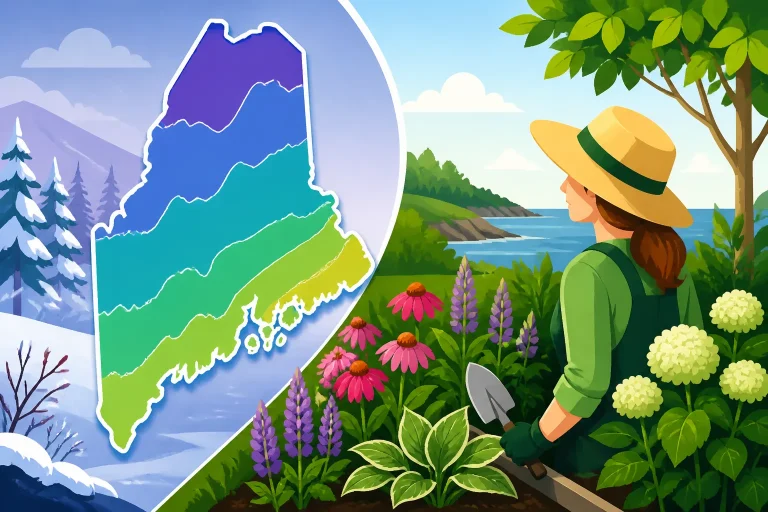
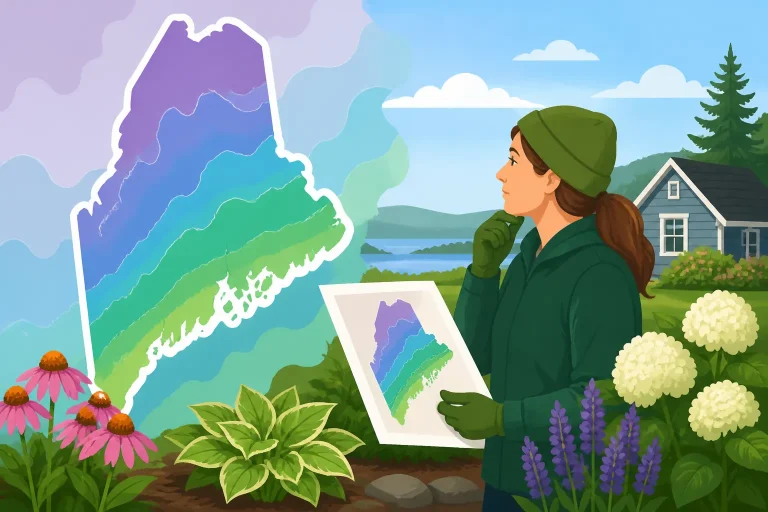
That is why a growing zone cannot answer the question on its own. The USDA Plant Hardiness Zone Map describes the average annual extreme winter low-temperature range for an area. It helps you judge whether a perennial may tolerate winter, but it does not tell you when the soil will warm, when frost risk has passed, or when to sow a vegetable. For that distinction, read Why Your Hardiness Zone Does Not Tell You When to Plant Seeds.
Frost estimates have a different purpose. A local estimate can help you judge the general risk of a spring freeze, but it is not a fixed finish line. Dates vary from year to year, and frost can occur in one part of a yard while another part stays above freezing. Use a nearby weather station’s information as a planning reference, then account for your garden’s microclimate.
A practical way to adapt a regional calendar is to treat its timing as a window and adjust it to your conditions. If your garden is cold and exposed, wait for stronger signs of spring. If it is warm and sheltered, some cool-season crops may be ready earlier, but that does not make tender crops safe to plant before they can handle cold nights. Shifting Vegetable Planting Dates Across Maine Regions offers more context on adjusting a schedule to regional differences.
Match the crop to the conditions
The simplest way to avoid a planting mistake is to group crops by how they respond to cold. Some can cope with chilly spring weather; others need settled warmth. The categories below are a useful guide, but check the instructions for the specific seed or plant you are growing.
| Crop group | Typical examples | What to check before planting |
|---|---|---|
| Cool-season seeds and crops | Peas, spinach, lettuce, radishes, and some root crops | Soil is workable, seed instructions suit cool conditions, and the bed is not waterlogged |
| Cold-tolerant transplants | Some brassica and leafy-crop starts | Seedlings are hardened off and can tolerate the forecast conditions |
| Warm-season crops | Tomatoes, peppers, cucumbers, squash, and beans | Soil and night temperatures are warming, frost risk is low enough for the crop, and plants are hardened off |
| Tender flowers and herbs | Many warm-season annuals and tender herbs | Cold nights and frost are unlikely, or reliable protection is available |
| Trees and shrubs | Container or bare-root woody plants | Soil is workable, planting conditions suit the stock, and roots can be cared for after planting |
Cool-season seeds
Cool-season crops are often the first vegetables to go outdoors because they can grow in cooler conditions than heat-loving crops. Peas and some greens, for example, may be sown while nights are still cool, provided the soil is workable and the seed’s directions support early sowing.
A seed can survive in cold ground without making useful progress. Germination may be slow, and prolonged cold, wet conditions can increase the chance of poor emergence or seed decay. The answer is not always to sow at the earliest possible opportunity. Wait until the bed can be prepared without compacting the soil, and follow the crop’s seed-packet guidance about sowing conditions.
For cool-season crops, a light frost may be less damaging than it would be for tender plants, but tolerance differs by crop and growth stage. Small seedlings can be more vulnerable than established plants. If a cold night is forecast, consider whether row cover or another suitable protection method is available. Working April Soil for Peas and Greens in Maine covers the practical question of when spring ground is ready for early sowing.
Cold-tolerant transplants
Some seedlings can be moved outside earlier than tender warm-season crops, but only after they have adjusted to outdoor conditions. A plant raised indoors has not had to cope with direct sun, wind, or sharp changes in temperature. Putting it straight into a garden bed can cause stress even if the weather is technically mild.
Hardening off is the gradual transition from sheltered growing conditions to outdoor conditions. It helps plants build tolerance before they face a full day outside. The process should reflect the weather: avoid exposing seedlings to severe conditions while they are adjusting, and bring them into shelter when conditions are unsuitable.
Planting depth and spacing should follow the crop’s instructions. Set seedlings into soil that is moist but not saturated, then water in as appropriate. Avoid planting a transplant simply because it has reached a certain size indoors; assess whether the garden and the plant are ready at the same time. See Hardening Off Maine Vegetable Starts Before Spring Frosts for a step-by-step approach.
Warm-season crops
Tomatoes, peppers, cucumbers, squash, beans, and other heat-loving crops are much less forgiving of cold conditions. Frost can injure or kill tender plants, while chilly soil and nights can slow growth even if frost does not occur. Waiting for reliably warmer conditions is usually a better trade-off than setting plants out early and hoping they recover.
A warm afternoon is not enough to judge readiness. Look at the pattern of nighttime conditions, the forecast, and the soil. A sunny day can make the garden feel ready while the ground remains cold underneath. A warm-season plant may also stall if its roots are placed into cool, wet soil.
If you are unsure whether to plant, hold warm-season seedlings in a protected spot and continue caring for them while you wait. Do not let them become root-bound or weak indoors, and give them the light and space they need. For a crop-by-crop overview, use Maine Vegetable Planting Schedule for Spring Through Fall alongside the guidance on your seed packet or plant label.
Trees, shrubs, and other perennials
“Planting outdoors” can also mean putting in trees, shrubs, and perennials. These plants do not all follow the same calendar as vegetable crops. Their planting window depends on whether they are bare-root, container-grown, or balled and burlapped, as well as on soil conditions and the needs of the plant.
For any woody plant, avoid working ground that is frozen, saturated, or so wet that digging leaves a slick, compacted surface. Protect roots from drying while planting and water as appropriate for the plant and conditions. Check nursery instructions for the stock type rather than applying a vegetable planting rule to a tree or shrub.
Perennials may survive winter in a suitable hardiness zone yet still be vulnerable to poor planting conditions or an unsuitable site. Consider drainage, sun, wind, and the plant’s mature size as well as its winter hardiness. Planting is safest when the soil can be prepared properly and there is time for the plant to establish under suitable conditions.
Check soil and weather before planting
The garden bed itself can tell you a lot. Soil that is too wet is easily damaged by digging, tilling, or walking on it. Working wet ground can press soil particles together, leaving compacted areas that are harder for roots and water to move through. Soil that is still frozen is not ready to prepare for planting either.
Try a simple field check: take a small amount of soil and squeeze it in your hand. If it is sticky, glossy, or forms a dense lump that does not break apart easily, it may be too wet to work. If it crumbles when handled and the bed is thawed, it may be closer to workable. Soil texture differs, so use this as a practical clue rather than a universal test.
Raised beds often drain and warm differently from in-ground beds, but that does not make them immune to cold nights or frost. A raised bed may be ready for sowing earlier, while tender transplants still need protection from cold air. Containers can warm quickly in the sun and cool quickly at night, so container plants need their own checks.
Before sowing, consider the following:
- Drainage: Does water stand on the bed, or does the soil drain after rain?
- Workability: Can you prepare the seedbed without kneading or compacting it?
- Temperature pattern: Are warm days followed by cold nights?
- Forecast uncertainty: Is a cold spell or frost still possible during the next several days?
- Protection: Can you cover or move vulnerable plants if conditions change?
- Seed instructions: Does the packet give specific guidance on soil warmth or sowing conditions?
A forecast is a planning tool, not a guarantee. Check it again close to planting, especially when tender crops are involved. A forecast for a nearby town may not reflect a colder hollow or a more exposed site. If an unexpected cold spell is possible and you cannot protect plants, postponing is often the lower-risk choice.
Keep a brief garden record as the season progresses. Note when beds become workable, when frost affects low spots, and how quickly a sheltered area warms compared with an exposed one. Those observations will not predict the weather, but they can help you make better decisions for your own yard next spring.
Harden off seedlings and protect early plantings
Indoor-started seedlings need a transition period before they can handle life outdoors. Even a plant that looks healthy on a windowsill may be unprepared for direct sunlight, wind, and changing temperatures. Hardening off helps reduce transplant shock and makes it easier to spot a plant that is struggling before it goes into the ground.
Start by placing seedlings outdoors in a protected location for a limited period, then increase their exposure gradually as conditions allow. Avoid beginning the transition during a spell of strong wind, intense sun, or very cold weather. Keep seedlings watered without leaving them in standing water, and bring them back to shelter when the conditions are too harsh for the stage they have reached.
A hardened-off seedling is not automatically frost-proof. Hardening helps it adjust to outdoor conditions, but it does not change a tender crop into a cold-tolerant one. Keep the plant’s cold tolerance and the forecast in mind even after it has completed the transition.
Protection can reduce risk for some early crops, but it cannot make every planting date safe. Row covers and cold frames can buffer plants from some cold conditions, depending on their design, the crop, and the weather. A cover also needs to be used in a way that does not overheat plants on sunny days or damage them through contact. Learn the limitations and setup considerations in Using Cold Frames and Row Covers to Buffer Late Maine Spring Frosts.
If you cover a bed, check the plants and the forecast rather than assuming the cover solves the problem. Strong winds can disturb a cover, and a severe cold event may exceed what a simple cover can protect against. Have a plan for uncovering or ventilating when conditions turn warm, and remove or adjust protection when it is no longer needed.
For seedlings in pots, temporary shelter can make it easier to respond to changing weather. Keep them where they receive suitable light and airflow, but avoid leaving them exposed to conditions they cannot tolerate. If seedlings are too large to manage indoors, use the time to prepare the bed and set up protection rather than rushing tender plants into cold soil.
A practical spring planting decision process
When deciding whether to plant, work through the same checks each time. This avoids relying on a single warm afternoon or a calendar date that may not fit your yard.
- Identify the crop and its cold tolerance. Read the seed packet, plant label, or reliable crop-specific guidance. Separate cool-season crops from tender warm-season crops.
- Check local frost information. Use a nearby weather station’s frost estimates as a probability, not a promise. Remember that your yard may be colder or warmer than the station location.
- Look at the short-term forecast. Check expected nighttime conditions and watch for a cold spell, not just the next sunny day.
- Assess the garden bed. Make sure the soil is thawed, workable, and not saturated. If digging smears or compacts it, wait.
- Assess the plant. For a transplant, consider its health, size, and whether it has been hardened off. For seed, follow instructions about sowing conditions.
- Decide whether protection is available. If frost is possible, determine whether you can protect the crop appropriately and reliably.
- Plant in stages when uncertainty remains. Sow or transplant a portion first, then follow with more when conditions improve. This spreads risk and gives you a chance to compare results.
- Recheck after planting. Watch the forecast, soil moisture, and plant condition. Respond to cold or dry conditions rather than assuming the planting is established.
Staggering plantings is especially useful for crops that can be sown more than once. If the first sowing struggles in cold ground, a later sowing may catch up as temperatures rise. Staging also helps when your garden has distinct microclimates: you can begin in the warmest bed and use the results to guide the rest.
If you have a short growing window, it can be tempting to plant everything early. But early planting is not always a shortcut. A crop that sits in cold soil or suffers cold injury may lose time rather than gain it. Starting some crops indoors, choosing crops suited to cool weather, or using protection can help extend the season without treating a risky planting date as safe. See When to Plant Seedlings Indoors for Maine Gardens for ways to plan indoor starts around outdoor conditions.
Common mistakes that make early planting riskier
Treating a frost estimate as a guarantee
A frost estimate describes odds based on past weather records. It does not promise that frost will stop on that date. Dates also vary from year to year, and frost risk can differ across a yard. Use estimates to plan, then keep checking the forecast.
Using a hardiness zone as a spring schedule
Hardiness zones are useful when choosing plants for winter survival. They do not measure spring soil temperature or tell you when to plant seeds. A perennial may be suited to a zone but still need a well-drained site, and a vegetable’s outdoor timing depends on its response to cold.
Planting all crops at once
Different crops have different needs. Putting peas, tomatoes, and basil out on the same day because the garden is open wastes the opportunity to use each crop’s tolerance. Plant cool-season crops when conditions suit them, and hold tender plants until their requirements are met.
Digging wet soil because the calendar says it is time
A date on a planting chart does not make a saturated bed workable. Turning or walking on wet soil can compact it and create problems that last beyond the planting day. Wait until the soil can be handled without smearing or sticking in dense clods.
Moving seedlings straight from indoors to the bed
A healthy-looking seedling still needs to adjust to outdoor light, wind, and temperature changes. Skipping hardening off can leave it stressed or scorched. Make the transition gradual, and remember that hardening off does not remove the plant’s need for frost protection.
Assuming a cover makes every crop safe
Row covers and cold frames can help buffer conditions, but they have limits. Their protection depends on the setup and the weather, and plants may still be damaged in severe cold. Plan to monitor covers and plants rather than treating protection as a guarantee.
Making a whole-garden decision from one spot
A sunny porch or a warm bed beside the house may create a misleading impression of the whole yard. Check the actual planting area, particularly if it is low, shaded, exposed, or slow to drain. Use the conditions where the roots will grow, not just how the air feels where you are standing.
Frequently Asked Questions
Is there one safe date to plant outdoors anywhere in Maine?
No. Safe timing depends on crop tolerance, local frost risk, soil conditions, and the garden’s exposure. A regional calendar can help narrow the window, but it cannot account for every yard.
Can cool-season vegetables go outside before the last spring frost?
Some cool-season crops can tolerate cool weather and may be planted before frost risk has ended. Check each crop’s guidance, make sure the soil is workable, and protect young plants if a damaging cold spell is forecast.
Does a warm afternoon mean it is safe to plant tomatoes?
Not by itself. Tender crops need conditions that are warm enough beyond a single afternoon. Consider nighttime temperatures, soil conditions, frost risk, and the plant’s instructions before transplanting.
If I harden off seedlings, are they protected from frost?
No. Hardening off helps seedlings adjust to outdoor sun, wind, and temperature changes. It does not make a tender crop frost-proof. Continue to consider the forecast and provide protection or wait when needed.
What should I do if I planted too early?
Check the forecast and assess the plants. If frost or a cold spell is expected, use suitable protection if available. Avoid adding stress by working saturated soil, and watch for signs of injury as conditions improve. Some plants may recover; others may need replacement.
Disclaimer
This article is for general informational purposes only and does not constitute professional advice. Laws, prices and regulations vary by location and change over time. Consult a qualified professional for guidance on your specific situation. Maine Gardening Guide is not a government agency and is not affiliated with any university extension, state department of agriculture or other government agency.