Finding Your USDA Hardiness Zone in Maine
Maine gardeners can use a USDA hardiness zone to narrow down which perennial plants may survive winter, but a ZIP-code result is not a complete planting plan. Coastal air, elevation, wind, snow cover, soil drainage, and spring frost all affect what succeeds. This guide explains how to find your zone, what the map can tell you, and how to use it without treating it as a guarantee.
What the USDA hardiness zone measures
The USDA Plant Hardiness Zone Map is a tool for comparing winter cold across locations. Its zones are based on the average annual extreme minimum winter temperature, calculated from weather observations over a 30-year period. The map groups locations into temperature bands, with smaller subdivisions within those bands.
The key word is “average.” A zone describes a pattern in historical winter lows, not the coldest temperature a place could ever reach. An unusually severe winter can fall outside the pattern, and a mild winter does not mean a plant is reliably hardy there. The map is useful for estimating the winter cold a plant may need to tolerate, but it cannot promise that a particular plant will survive.
Plant labels and nursery catalogs often show a hardiness zone or range. That rating is a starting point for comparing a plant’s cold tolerance with the zone where your garden falls. It does not tell you whether the plant will thrive in your soil, receive enough sun, tolerate summer conditions, or get through a winter with exposed roots.
For Maine gardeners, that distinction matters because conditions can change over short distances. A coastal site, a sheltered town garden, a windy ridge, and a low-lying inland yard may experience different combinations of cold, wind, snow, and moisture. The USDA map provides a broad regional reference; your yard still has its own growing conditions.
A hardiness zone is also different from a frost date or growing-season estimate. The zone focuses on winter minimum temperatures. Frost dates describe the likelihood of spring or fall freezes at a particular weather station or site. The number of days between those events can help you assess whether a vegetable or annual has enough time to mature. For more on that distinction, see Why Your Hardiness Zone Does Not Tell You When to Plant Seeds and How to Read Local Frost Dates for Your Maine Garden Site.
How to find your USDA hardiness zone in Maine
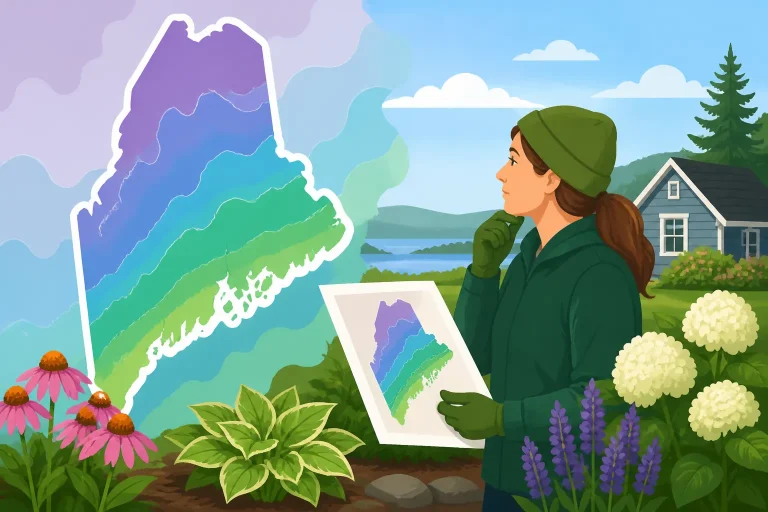
Start with the official USDA Plant Hardiness Zone Map. Search for your town or ZIP code using the map’s location tool, then inspect the map around the result rather than relying only on the search label. A ZIP code covers an area, and a location near a zone boundary may not match the conditions in every part of that ZIP code.
A useful process is:
- Search for your town or ZIP code. Use the official USDA map to get an initial location result.
- Check the map around the result. Look for nearby zone boundaries and note whether your area sits close to one.
- Compare more than one local point if needed. If your home is outside the town center or near a change in elevation, inspect the map around the actual area where you garden.
- Treat the result as a regional estimate. Do not interpret a ZIP-code search as a measurement at a specific house or planting bed.
- Use the zone to screen plant choices. Check a plant’s stated hardiness rating, then consider other conditions such as exposure, soil, and drainage.
A map result is most useful when you understand its limits. It tells you how the mapped area compares with other places in terms of average extreme winter cold. It does not measure your garden’s air temperature, soil temperature, snow depth, or wind exposure. Nor does it account for every sheltered nook, slope, or heat-retaining surface around a home.
If the search result seems surprising, check the map itself and look for nearby boundaries. Avoid assuming that the town’s general result describes every neighborhood equally. Maine Planting Zones: How to Check Your Town by ZIP Code offers more detail on using a location lookup, while Reading the USDA Plant Hardiness Zone Map for Maine Yards explains how to interpret the map’s colors and boundaries.
Why Maine zones can change across short distances
Maine’s landscape includes coast, interior, higher elevations, valleys, and exposed uplands. Those differences can shape winter conditions, so the map may show boundaries crossing a relatively small area. A town name alone does not explain the conditions at an individual garden.
Coastal locations can experience the influence of nearby ocean water, while inland sites may have different winter temperature patterns. Elevation and exposure also matter: a garden on a hilltop may be more exposed to wind than one protected by nearby terrain or buildings. These patterns do not mean every coastal yard is mild or every inland yard is colder. They are reasons to check the mapped location and the immediate site, rather than relying on a broad regional label.
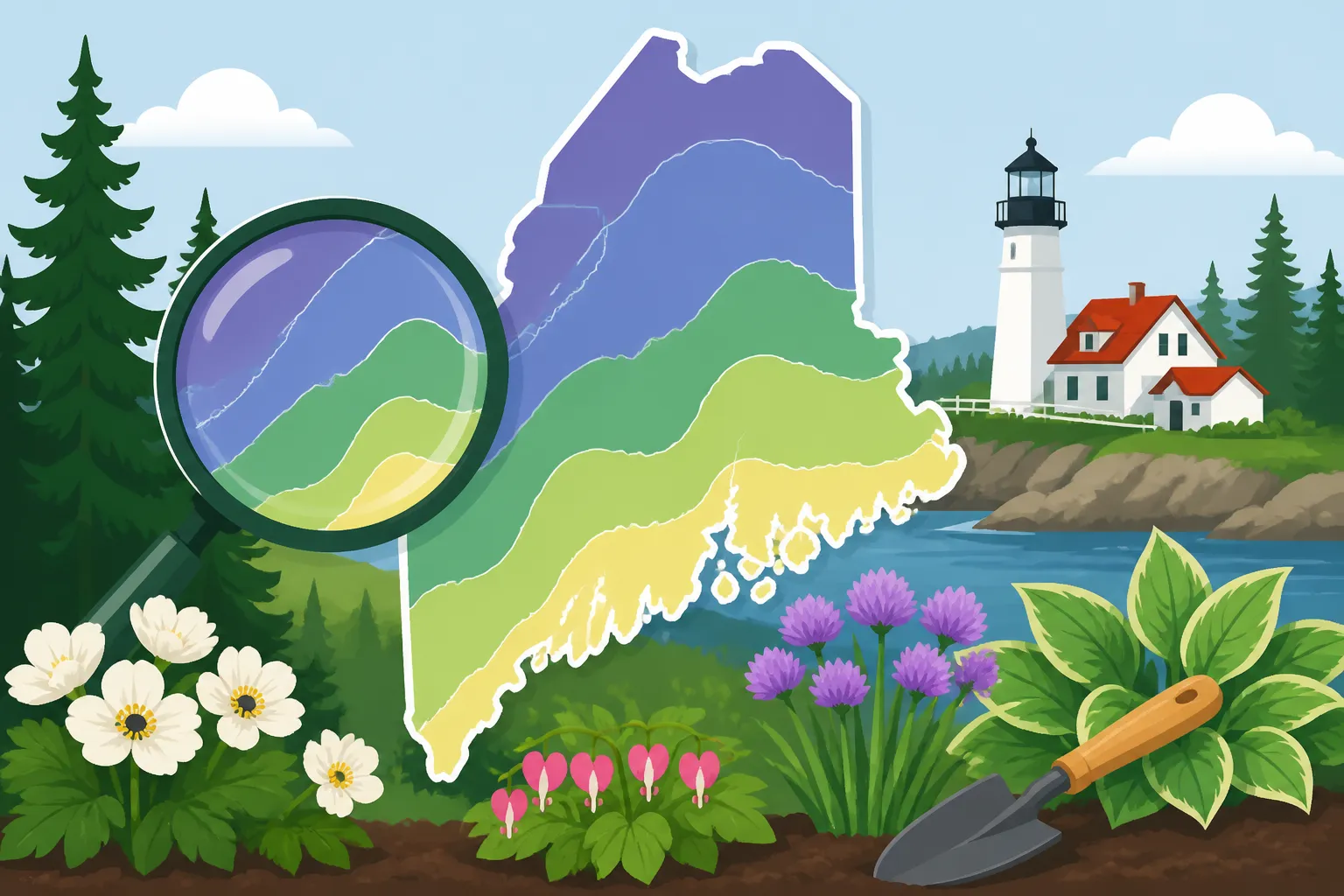
The USDA map is not a neighborhood-scale weather forecast. It divides land into mapped zones, but the boundaries are not physical walls. Nearby properties on either side of a boundary do not suddenly have completely different climates. A line on the map marks a transition in the data used to create the map, and local conditions can blur the distinction.
When a garden lies close to a boundary, use the result cautiously. Compare the zone rating of a plant with the mapped estimate, but also consider whether the plant has a record of doing well under your site’s exposure and soil conditions. If a perennial is rated only for conditions warmer than the location where your garden falls, winter survival may be less dependable. A plant rated for colder conditions may have a wider safety margin, but it still needs suitable moisture, light, and growing conditions.
A sheltered courtyard and a windswept slope in the same town can also behave differently. Buildings, walls, trees, and fences may reduce exposure or hold warmth, while open areas can experience more wind. Such features can create a microclimate, but they do not erase every risk. A wall that shelters a plant from wind may also create a warm spot that encourages earlier growth, leaving new growth exposed if cold returns.
For a closer look at local differences, read Coastal vs Inland Microclimates in Maine Hardiness Zones and Understanding Hardiness Zone Boundaries for Maine Gardens. The practical takeaway is simple: use the map to establish a regional baseline, then pay attention to the exact place where each plant will grow.
What a hardiness zone can and cannot tell you
The zone is a useful filter when you are comparing trees, shrubs, and perennials that need to survive outdoors through winter. It can help you rule out a plant whose stated cold tolerance is a poor match for the mapped conditions. It can also help you compare two varieties of the same type of plant when their listed ratings differ.
But a zone is only one part of plant suitability. A plant can be hardy enough to endure winter cold and still struggle because its roots sit in saturated soil, it receives too little sun, or its growing season is not long enough to flower or produce a crop reliably.
| Question | What the zone helps with | What else to check |
|---|---|---|
| Could this perennial survive typical winter lows here? | Provides a regional cold-hardiness estimate | Wind exposure, snow cover, drainage, and site shelter |
| Is this tree or shrub a reasonable candidate? | Helps screen its listed winter tolerance | Mature size, soil, sun, moisture, and exposure |
| Will this vegetable ripen before fall cold? | Very little on its own | Days to maturity, local frost patterns, and planting timing |
| Is this the right place to plant it? | Does not assess the planting spot | Sun hours, slope, soil texture, moisture, and nearby structures |
| Will it survive an unusually harsh winter? | Cannot guarantee survival | Plant health, establishment, winter protection, and weather |
It does not give you planting dates
A hardiness zone does not tell you when to sow seeds, set out transplants, or plant a fall crop. Those decisions depend on the crop, local soil and weather, expected spring and fall freezes, and how much time the plant needs to mature. A vegetable that can tolerate Maine winters may still need a particular season or planting window to produce well.
For example, a warm-season crop may require warm soil and settled conditions even if it can grow within the broad climate represented by the zone. Conversely, cool-season crops may tolerate chilly weather but still need attention to soil readiness and the timing of likely freezes. Use crop-specific timing information rather than trying to convert a hardiness zone into a planting calendar. Maine Vegetable Planting Schedule for Spring Through Fall and Spring Sowing Windows for Central, Coastal, and Northern Maine address those timing questions.
It does not describe the whole growing season
The winter minimum used for a zone does not tell you how long the frost-free growing period lasts. Two locations that fall in the same zone can still differ in spring warming, fall cooling, or the time available for crops to mature. That matters for vegetables and fruits that need a longer stretch of suitable weather.
For short-season crops, check how long the variety takes to mature and compare that with local growing-season information. For more detail, see Freeze-Free Growing Season Length Across Maine Weather Stations and Planning Short Season Crops by Counting Freeze-Free Days in Maine.
It does not measure every kind of winter stress
Cold is not the only winter challenge. A plant may be exposed to drying wind, repeated thawing and refreezing, wet soil, or limited snow cover. Snow can insulate soil and roots, but cover varies from place to place and from winter to winter. A plant’s hardiness rating cannot account for the exact protection your garden receives.
Moisture matters in every season. Roots that remain waterlogged may be more vulnerable to damage than roots in well-drained soil. A site that dries quickly can also stress a plant, particularly while it is establishing. Check whether a plant’s preferred conditions match the soil and drainage where you plan to put it.
It does not guarantee success for tender growth
A perennial may survive winter while its early shoots, flower buds, or fruiting potential are affected by weather later in the season. A warm spell can encourage growth before conditions are stable. A later freeze may damage tender growth even if the plant itself is winter-hardy. This is one reason a plant’s winter rating cannot replace information about its seasonal needs and local frost risk.
Using your zone to choose plants
Once you have a reasonable map result, use it as an initial screening tool rather than a final verdict. Read the plant label carefully and check whether the stated range includes the zone where your garden falls. Then ask whether the plant’s other needs match the site.
Compare plant ratings with your location
For a long-lived perennial, tree, or shrub, winter survival matters over many years. If the plant’s label identifies a colder range than the map suggests for your location, the plant may have a useful margin for winter cold. If the plant is at the edge of its stated tolerance, success may depend more heavily on site shelter, drainage, establishment, and winter conditions.
A rating is not a guarantee in either direction. A plant labeled hardy for your zone can still fail if it is planted in a wet pocket or an exposed location that does not suit it. A plant near the edge of its range may succeed in a sheltered garden, but that is less predictable than choosing a plant with a comfortable margin. How to Evaluate Winter Hardiness Before Buying Perennials explains how to weigh a rating before purchasing.
Look beyond the zone on a label
Before choosing a plant, check:
- Light: Does it need full sun, partial shade, or shade, and does the intended spot provide that?
- Soil drainage: Does it tolerate wet soil, or does it need a site that drains readily?
- Moisture: Will it suit the garden’s usual moisture conditions after establishment?
- Exposure: Is the site sheltered, windy, or open to winter weather?
- Space: Will the mature plant fit without crowding paths, buildings, or other plants?
- Season length: For crops and fruit, does the plant have enough time to mature or produce?
- Establishment: Can you give a newly planted specimen suitable care while its roots develop?
These checks are particularly useful when buying plants from a catalog or garden center. A hardiness label may summarize winter cold tolerance, but it does not substitute for the plant’s full growing requirements. If a label provides limited information, look for a detailed description from a reliable nursery or gardening reference before making a decision.
Give extra thought to borderline choices
Some gardeners are willing to experiment with a plant near the edge of its hardiness range. That can be a reasonable choice if you understand that survival is less certain and you are prepared to replace the plant. For a centerpiece tree or a large, costly planting, a better-matched option may be the safer choice.
For border-line perennials, consider the location within the yard as well as the map result. A spot protected from strong wind and with well-drained soil may be more suitable than an exposed or persistently wet location. However, do not count on a sheltered spot to overcome a major mismatch between the plant’s cold tolerance and the site.
Cold tolerance can also vary among cultivars within a plant type. When choosing a named variety, check its specific rating rather than assuming all varieties have the same hardiness. The same principle applies to fruit trees, shrubs, and perennial flowers: use the rating for the plant you are actually buying, not a generalized description of the species.
Reading your yard beyond the map
A map provides a regional estimate, while the garden site determines how that estimate plays out. Walk the yard at different times and note features that may affect temperature, wind, light, and moisture. This does not produce a new official zone for your property, but it helps you select a planting location that suits the plant.
Notice exposure and shelter
Observe whether the planting area is open to winter wind or protected by nearby structures and vegetation. A fence or building may reduce exposure in one direction, while a gap between buildings can funnel wind. A sheltered position can reduce some stress, but it may not be a good fit for plants that need cooler conditions or strong airflow.
Pay attention to the direction of slope and the surrounding terrain. Low areas can collect cold air or water, while exposed high points may face more wind. The effect varies by site, so avoid using a single feature as a guarantee. Treat it as one clue alongside the plant’s requirements.
Check sun and shade through the seasons
Sun exposure affects more than summer warmth. Deciduous trees can allow more light through after leaf drop than during the growing season, while buildings may cast long shadows at particular times of day. A spot that seems sunny during one visit may receive less useful light over the full day or season.
Match the plant’s light requirements to what the location actually receives. A hardy plant can still grow poorly in unsuitable light, and a plant stressed by poor growing conditions may be less resilient when winter arrives. For site-planning help, see Assessing Sunlight, Slope, and Soil Moisture Before Planting in Maine.
Pay attention to drainage and soil moisture
Notice where rainwater drains, pools, or runs off. Soil that remains saturated for long periods can create problems for plants that require good drainage. Sandy or raised areas may dry more quickly, which can be a challenge for plants that need consistent moisture. The USDA zone map does not show these differences.
If you are unsure about the soil, observe how it behaves after rain and during dry spells. Check whether the intended location has compacted or disturbed soil, shallow ledge, or other constraints that affect roots. For important plantings, soil information can help you decide whether a site is suitable or needs preparation. What Factors Besides Minimum Winter Cold Limit Maine Plants? covers several of these non-temperature limits.
Keep a simple site record
A small amount of observation can make future choices easier. Record the map result for your general area, note the conditions of specific garden spots, and track which plants handle winter well. You might note whether a location is windy, shaded, wet, or quick to dry, and whether snow tends to remain there.
Keep those notes practical. The goal is not to create a precise temperature record for every bed; it is to remember useful patterns. If one sheltered bed consistently supports plants that struggle elsewhere, that information can guide future placement. If a wet corner damages plants, choose species suited to those conditions or consider another planting location.
A practical way to use the zone in a Maine garden plan
A hardiness zone works best as one part of a simple decision process. Use it first to screen choices, then combine it with information about frost, season length, site conditions, and plant needs.
- Find the mapped zone for your general location. Use the official USDA Plant Hardiness Zone Map and inspect nearby boundaries, especially if your area lies close to one.
- Check the plant’s own hardiness information. Use the rating for the specific species or cultivar, not a broad assumption about the plant group.
- Decide how much risk is acceptable. A plant near the edge of its rating may be an experiment; a major long-term planting may justify choosing a more reliably matched plant.
- Assess the planting site. Consider exposure, shelter, light, soil drainage, moisture, and available space.
- For edible crops, check timing separately. Use crop-specific planting guidance, frost information, and days to maturity rather than relying on the zone alone.
- Review the plant after winter. Note whether it survived, whether it suffered damage, and whether the site seems to be the issue.
- Adjust future choices. Use both the map and your own observations to choose plants and locations more carefully.
A practical record can include the plant name, where it was planted, the site’s sun and drainage, and its condition after winter. If a plant fails, do not assume the zone was wrong. Consider whether it was newly planted, exposed to wind, sitting in wet soil, or stressed by drought before winter. Those factors can help explain the outcome and guide a better choice next time.
Use frost and planting resources for time-sensitive decisions. Frost probabilities vary from year to year, so a typical date is not a promise that a freeze will not occur. For vegetables, seed starting and transplanting advice should account for crop type and regional conditions. Using Spring Freeze Risk Dates to Decide When to Plant in Maine can help connect local freeze risk with planting decisions.
The central rule is to use the USDA zone as a filter, not as a verdict. It can narrow the list of plants worth considering, especially for trees, shrubs, and perennials. Your site’s exposure, soil, moisture, and growing-season timing determine whether that plant is a good match for the particular place you want to grow it.
Frequently Asked Questions
Does a ZIP code give the exact hardiness zone for my garden?
No. A ZIP-code search gives a useful starting point for a broader area, but a ZIP code can include more than one set of local conditions. Check the map around the result, especially if your garden is near a boundary or differs from the town center in elevation or exposure.
Is my hardiness zone the same as my frost date?
No. A hardiness zone summarizes average annual extreme winter minimum temperatures. Frost dates estimate the likelihood of spring or fall freezes at a location. They answer different questions, so use both types of information when planning.
Can a plant rated for my zone still die over winter?
Yes. A hardiness rating is not a survival guarantee. Soil that stays wet, exposure to wind, lack of snow cover, poor establishment, and other conditions can affect winter survival. The plant also needs suitable light and moisture during the growing season.
Should I choose plants rated for a colder zone than my garden?
A plant with a rating that includes colder conditions may provide more margin against winter cold, but that rating alone does not ensure success. Check the plant’s other needs and the conditions at the intended site. A plant that is poorly matched to soil or moisture can still struggle.
Disclaimer
This article is for general informational purposes only and does not constitute professional advice. Laws, prices and regulations vary by location and change over time. Consult a qualified professional for guidance on your specific situation. Maine Gardening Guide is not a government agency and is not affiliated with any university extension, state department of agriculture or other government agency.